
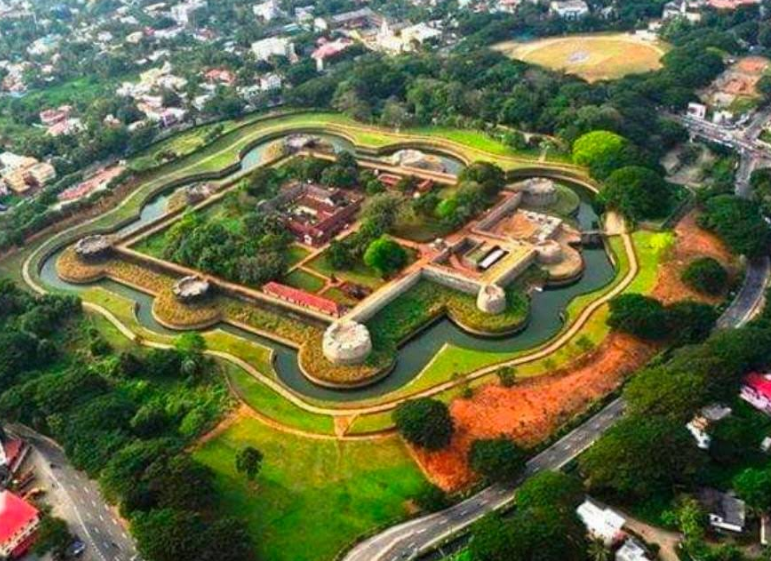
Palakkad Fort — also known as Hyder Ali Fort or Tipu's Fort — stands in the heart of Palakkad town as one of Kerala's best-preserved 18th-century military structures. Constructed in 1766 from locally quarried granite, it has witnessed Mysore dominion, British colonial rule, and independent India's care, surviving each era with its massive walls largely intact.
Historical Significance
In 1757, when the Samuthiri (Zamorin) of Kozhikode launched an invasion of Palakkad, the local king sought assistance from Hyder Ali of Mysore. With Hyder Ali's support the Zamorin was compelled to retreat. Hyder Ali then conquered all territories previously held by the Zamorin and, to consolidate his hold on the Palakkad Gap — the only major break in the Western Ghats — he constructed the fort in 1766 as a strategic military outpost and administrative centre.
The fort served as the nerve centre of Mysore power in Malabar under both Hyder Ali and his son Tipu Sultan, controlling the critical trade and military corridor between the Deccan and the Malabar coast.
Construction & Architecture
The fort is a well-preserved example of 18th-century military architecture. Its key features:
British Era
The Treaty of Srirangapatna (1792) transferred Tipu Sultan's Malabar possessions to the British East India Company — and with them, Palakkad Fort.
The British used the fort as a military garrison and administrative centre. While some modifications were made to suit colonial needs, the core granite structure remained largely untouched — a testament to the quality of Hyder Ali's original construction.
Present Day
Today the fort is an ASI-protected monument open to all visitors free of charge. The compound contains:
- The original fort walls and bastions
- A small museum with artefacts and historical information
- Well-maintained gardens and open lawns
- An open-air auditorium for cultural programmes
The fort hosts exhibitions, cultural events, and school visits throughout the year, keeping its heritage alive in the daily life of Palakkad.